One window, two published U-values, differing by about fifteen per cent. Both were produced by recognised methods, both are reproducible, and the difference is entirely in how the areas and the perimeter were counted.
Two U-values for the same window, both correct
rev Cwritten 2026-07-24issue 04rev Crots yes — the figures above move with the standarddrawn by The Transom Set (a named set, not a person)
Where the two routes diverge
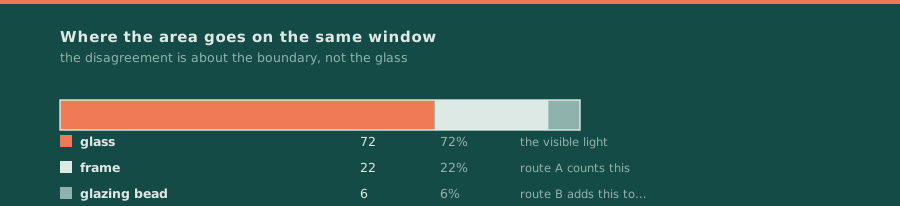
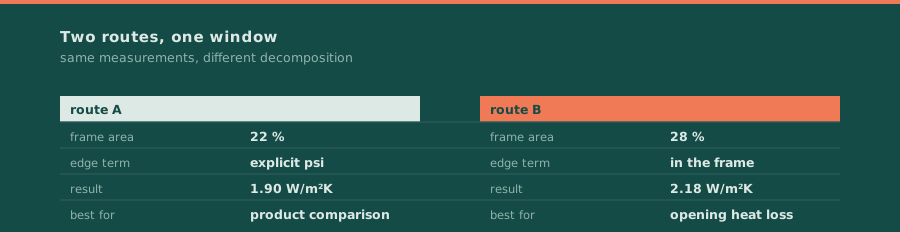
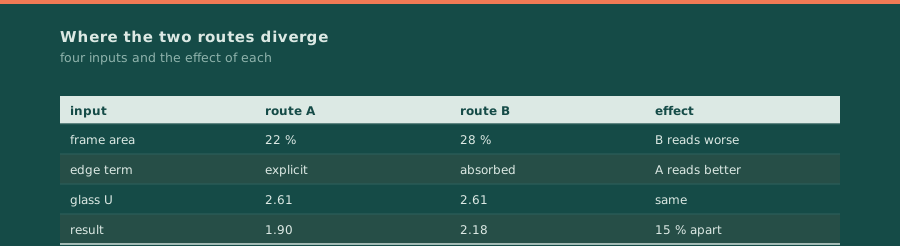
Both routes use the same three-part model: glass, frame, and a linear term at the edge. They disagree about two inputs. The first is where the frame ends and the glass begins, which is a decision about whether a 20 mm glazing bead counts as frame. The second is whether the edge term is calculated from the spacer's psi or absorbed into the frame's own U-value.
| Input | Route A | Route B | Effect |
|---|---|---|---|
| frame share of area | 22 % | 28 % | route B reads worse |
| edge term | explicit psi | absorbed into frame | route A reads better |
| glass U | 2.61 W/m²K | 2.61 W/m²K | same |
| result | 1.90 W/m²K | 2.18 W/m²K | 15 % apart |
Both are defensible
Route A is right if the question is how much heat the window passes as a product, because it treats the edge as the separate physical thing it is. Route B is right if the question is how much heat crosses the opening, because it charges everything outside the visible glass to the frame. Neither is a mistake, and a comparison between a figure from one route and a figure from the other is a comparison of two different questions.
This is not a defect in the standards. It is a consequence of defining a three-dimensional assembly through a two-dimensional decomposition, and every decomposition makes a choice at the boundary. What matters is that the choice is stated.
Two U-values for one window is not the same as an error. It is a signal that the two figures were produced under different conventions, and the useful response is to find out which convention each one used rather than to decide which is right.
What this changes
It changes how a comparison should be read. Any table that ranks windows by U-value without stating the route is comparing figures that may not be commensurable, and the ranking may be an artefact of the convention rather than a difference in the products. It also changes what to ask for: not the U-value alone, but the U-value with its route, its areas and its edge treatment.
Documents this sheet is drawn from
- 1BS EN 673:2024 Glass in building - Determination of thermal transmittance (U value) - Calculation methodsupports the European calculation method for glass thermal transmittance used by route A
- 2EN 673:2024 Glass Thermal Transmittance U Value Calculation Method (iTeh catalog)supports the standard's published calculation method and its stated conventions
- 3NFRC Technical Bulletin 2025-03: Publication of Revised ANSI/NFRC 100 and ANSI/NFRC 200supports the current revision of the product U-factor procedure that route B follows
Each line points at one specific document, with its own title as the link text. No line is a home page and no line is a search result.
Sign the sheet and stop Sign the sheet and stop once you know which convention each figure used. Then compare, or do not.