A solar control coating is a stack of metal and oxide layers a few hundred nanometres thick, deposited on one face of a glass pane. Which face it is on decides whether it keeps heat in, keeps heat out, or does both badly.
Solar control coating: the surface decides the number
rev Cissue 04rev Crots yes — the figures above move with the standarddrawn by The Transom Set (a named set, not a person)
Which face is which
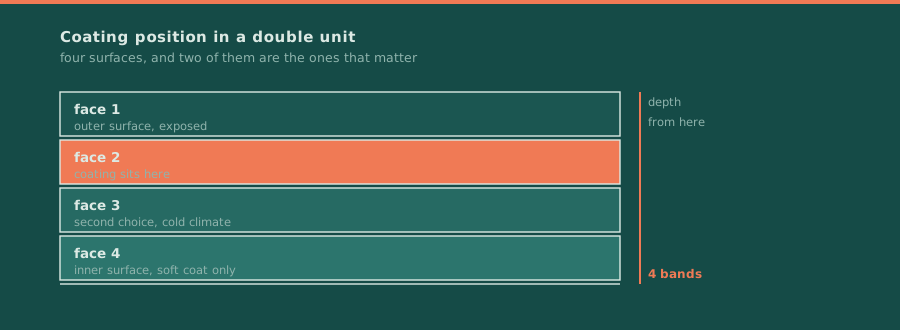
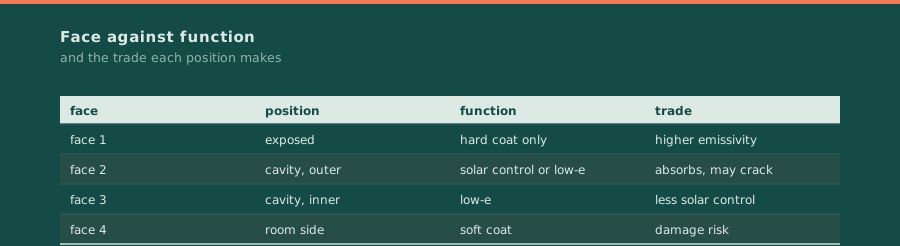
Surfaces are numbered from the outside in. On a double unit, face 1 is the outer pane's outer surface and face 2 is its inner surface facing the cavity. Low-e coatings for cold climates go on face 2 or face 3, where they face the cavity and reduce radiative exchange across it. Solar control coatings for hot climates go on face 2, where they absorb and re-radiate outward as well as inward.
| Face | Where it is | Effect | Used for |
|---|---|---|---|
| face 1 | outer surface | exposed, easily damaged | rarely coated |
| face 2 | cavity side of the outer pane | low-e or solar control | most common |
| face 3 | cavity side of the inner pane | low-e, cold climate | heating dominated |
| face 4 | inner surface, in the room | soft coat, low emissivity | specialist |
Two numbers move in opposite directions
A coating that blocks solar heat also blocks some daylight, and the visible transmittance falls with the solar heat gain. That trade is the design decision, and it is expressed as a ratio: light to solar gain. A ratio of 1.0 means the glass passes daylight and heat in the same proportion; a ratio of 2.0 means it passes twice as much light as heat, which is what a hot-climate facade wants.
The soft-coat problem sits on top of that. A sputtered low-e coating is soft and has to be sealed inside a cavity, which is why it is almost always on face 2 or 3 and almost never on a monolithic pane. A pyrolytic coating is hard enough to be exposed, at the cost of a higher emissivity.
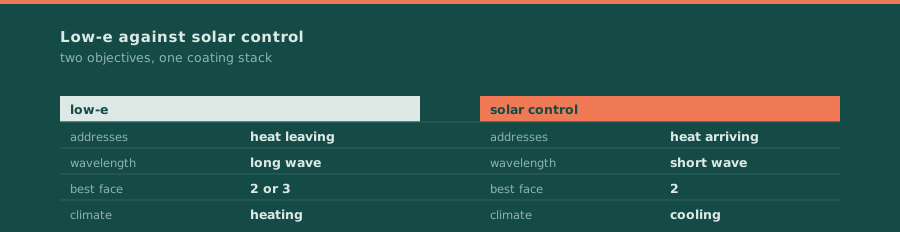
A low-e coating is not the same as a solar control coating, although a single product can be both. Low-e is about long-wave radiation leaving the building; solar control is about short-wave radiation arriving from the sun. A coating optimised for one is usually a compromise on the other.
Where the definition stops
This page owns the coating. The unit it is deposited on is owned by the unit page, the edge it leaves cold by the spacer page, and the U-value it produces by the U-value test. Nothing here is repeated there.
Documents this sheet is drawn from
- 1Low-E glass: low emissivity and energy efficiency glass coating (Guardian Glass)supports the low-emissivity coating behaviour and surface placement described here
- 2Glass Technical Paper FB63-19: Products for Energy Applicationssupports the range of coated products and their energy applications
- 3NSG TEC Performance Data Summary (Pilkington)supports the measured performance data for a coated solar-control product
Each line points at one specific document, with its own title as the link text. No line is a home page and no line is a search result.
Sign the sheet and stop Sign the sheet and stop once you know which face the coating is on and which two numbers it moves. The rest of the glazing order follows.