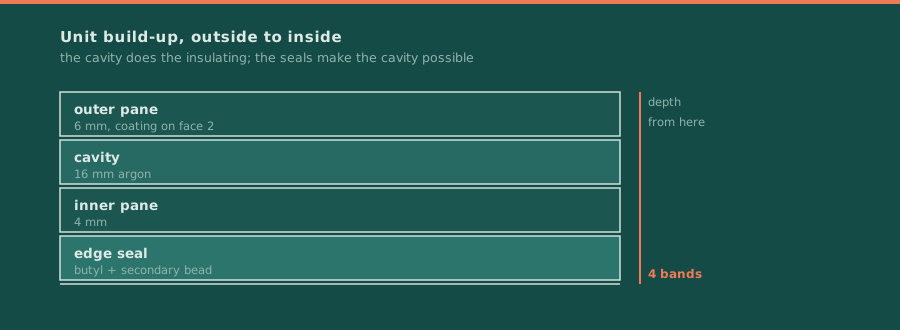
An insulating glass unit is two or more panes held apart by a spacer and sealed around the perimeter, with the cavity filled with air or a gas. The cavity is what insulates. The seal is what makes the cavity exist, and the seal is what fails first.
Insulating glass unit: the cavity and the seal that keeps it
rev Cissue 04rev Crots yes — the figures above move with the standarddrawn by The Transom Set (a named set, not a person)
What the cavity holds
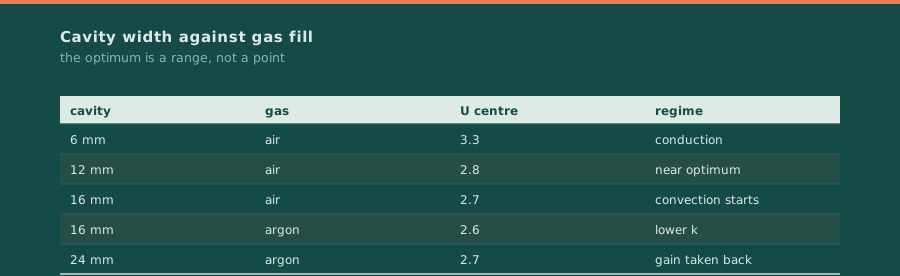
A dry-air cavity of 12 to 16 mm is the cheapest insulation in a window and it is the reason the unit exists. Widening it past about 16 mm does not help, because convection starts moving heat across the gap faster than conduction was carrying it. Filling the same cavity with argon or krypton lowers conduction again, which is why a 16 mm argon cavity performs about as well as a 20 mm air cavity that would have convected.
| Cavity | Gas | Centre-of-glass U (approx.) | Why |
|---|---|---|---|
| 6 mm | air | 3.3 W/m²K | conduction dominates, gap too thin |
| 12 mm | air | 2.8 W/m²K | near the optimum for air |
| 16 mm | air | 2.7 W/m²K | optimum, convection starting |
| 16 mm | argon | 2.6 W/m²K | lower conductivity gas |
| 24 mm | argon | 2.7 W/m²K | convection has taken back the gain |
The seal is the unit
Two seals do two different jobs. The primary seal is a butyl bead against the spacer that stops water vapour getting in. The secondary seal is a polysulphide, polyurethane or silicone bead that holds the two panes together structurally. A unit with a good primary seal and a failed secondary seal still fogs, because the panes move and the primary bead is torn open by the movement.
This is why the durability test is a cycling test rather than a static one. The unit is put through hundreds of temperature cycles and then measured for moisture ingress, because a static test would pass a unit that cannot survive a summer.
Fogging is a symptom, not the failure. The failure is at the edge, and by the time the fog appears at the bottom corner the primary seal has usually been open for years. A fogged unit is not the same as a wet unit, and a wet unit is not the same as a structurally loose one — the three have different causes and different remedies.
Where the definition stops
This page defines the unit and its cavity. The spacer bar and the edge seal are owned by the spacer page, the coating on the glass by the solar control page, and the number that comes out of the whole assembly by the U-value test. Nothing here is repeated there.
Documents this sheet is drawn from
- 1ASTM E2190 Standard Specification for Insulating Glass Unit Performance and Evaluationsupports the durability cycling requirement the unit has to survive
- 2Glass Technical Paper FB49-17: Performance Improvements in Insulating Glass Units - Cavity Gap and Insulating Gasessupports the cavity gap and gas-fill figures quoted in the table above
- 3Window Seal Failures - causes of IGU seal failure and fogging (Abbott Consulting Forensics & Design)supports the failure sequence from primary seal to visible fogging
Each line points at one specific document, with its own title as the link text. No line is a home page and no line is a search result.
Sign the sheet and stop Sign the sheet and stop once you know the cavity width and the gas. Everything else on a glazing order follows from those two.